My Journey
I've Always Been a Teacher
A career of translating complex ideas into meaningful human connection.
_JPG.jpg)
I've always been a teacher — even before I realized teaching would become part of my career.
When my family moved from Puerto Rico to Northern Virginia, I was nine years old. Although I already spoke English, I asked to attend summer school to strengthen my language skills before starting school in Virginia. A few years later, I volunteered to tutor Spanish-speaking ESL students at my high school, hoping to give others the same confidence and support that had helped me. Working with classmates from across Latin America broadened my understanding of culture, identity, and belonging, and taught me early that communication can either open doors or create barriers.
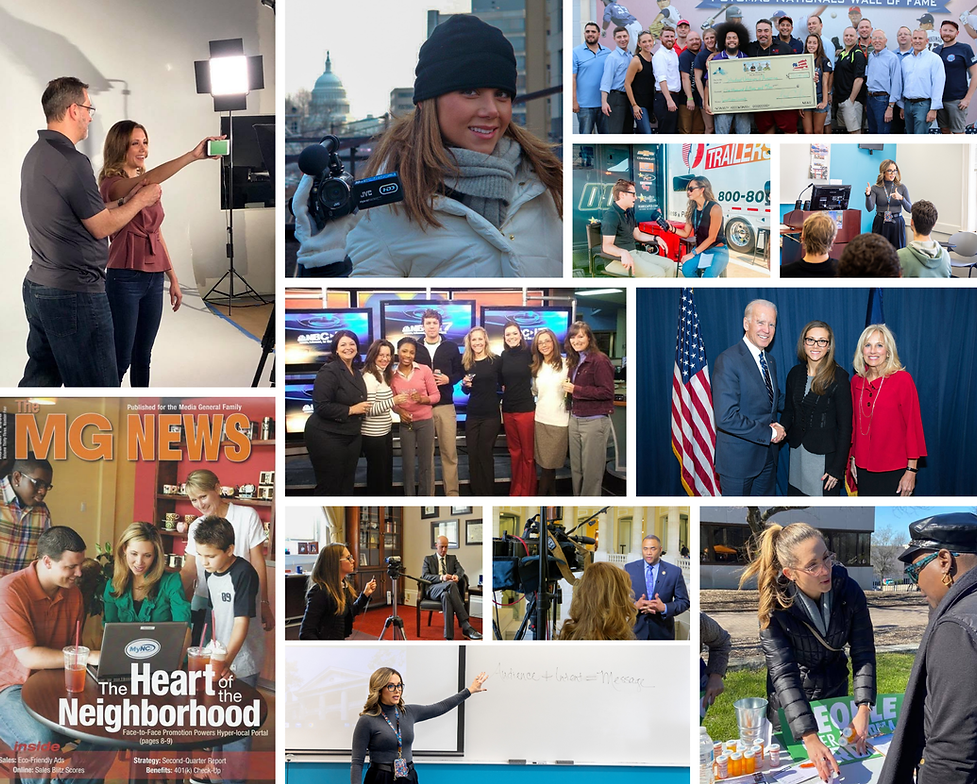
Long before I stood in front of a college classroom, those experiences shaped the way I approached communication: not simply as the exchange of information, but as a way to help people understand, connect, participate, and thrive. As a bilingual journalist, I anchored the evening news at Univision 40 and covered two U.S. presidential elections in Spanish and English, translating complex issues into information families could use to make informed decisions. Later, in public affairs, nonprofit leadership, and strategic communication, that responsibility took different forms: explaining public policy, humanizing research through real stories, connecting organizations with the communities they served, and helping clients communicate with greater clarity, empathy, and purpose.
As a first-generation college student, I have always viewed education as something to be shared, not simply earned. That belief eventually brought me into the classroom at William Peace University, where teaching allows me to help the next generation of communicators develop their own voices while continuing to learn alongside them. I often tell my students, “Don’t just tell them -- show them.” In return, they continually challenge me to explain not only what works, but why it works.
The roles have changed. The audiences have changed. But the mission has remained remarkably consistent: I believe communication is, at its heart, an act of education. That belief ultimately brought me back to the classroom in another role: as a graduate student in the Master of Arts in Integrated Marketing Communication program at the University of North Carolina Wilmington (UNCW). After more than twenty years as a communication practitioner, I wanted to better understand the research, theory, and ethical frameworks behind the work I had spent my career doing. The program transformed years of practice into more intentional, evidence-based expertise while reaffirming something I had believed since childhood: learning and teaching are lifelong pursuits that continually strengthen one another.
This portfolio documents that evolution through three interconnected themes: Strategic Communication & Professional Positioning; Ethics, Diversity & Inclusion; and Integrated Campaign Development & Knowledge Translation. Together, these projects demonstrate more than what I have learned through graduate study and professional practice. They show how I apply that knowledge—to analyze problems, develop thoughtful communication strategies, tell more inclusive stories, and translate complex ideas into meaningful action.
Whether I am in the classroom, at the consulting table, or helping an organization connect more meaningfully with the people it serves, my goal remains the same: to use communication to open doors for learning, understanding, and opportunity.
I hope you'll do more than read my story.
My hope is that you’ll be part of the next chapter.
Let’s connect.
“I believe communication is, at its heart, an act of education.”
Jessica Coscia
My Communication Style
Understanding how I communicate and how others experience that communication has been part of my professional development throughout the UNCW IMC MA program. The Forté Communication Style Report is a widely used tool in coaching and organizational settings to help professionals understand their natural communication strengths and adapt them effectively across audiences.
In May 2026, I completed a Forté Communication Style assessment, which reflected that my primary strength is Conformity+, a systems-oriented style associated with precision, thoroughness, and a strong sense of fairness and duty. Paired with a secondary strength in Non-Dominance, described as a cooperative, unassuming orientation, the profile portrays someone who works carefully within clear structures, holds fairness as a core value, and prefers to build consensus rather than unilaterally dictate decisions.
These tendencies show up directly in how I teach and communicate professionally. I build detailed rubrics and clear expectations for students, lean on evidence and fairness when giving feedback, and care about creating structured, predictable environments where people know what's expected of them and what they should expect of me.
At the same time, my profile also reflects persuasive, people-oriented qualities that surface in my collaborative approach to client work and my emphasis on building trust through consistency and empathy, reinforcing what I described earlier in my professional signature story: communication as a way to connect people, not just inform them.